
Most versions of this debate start in the wrong place. They compare hourly rates — ₹1,500 an offshore developer against a ₹25 lakh in-house salary — and call it a business case. That comparison tells you almost nothing about whether the work will actually ship on time, hold up under load, or survive the first six months after launch.
The real question isn't "which costs less." It's "which model reduces delivery risk for this program, at this stage of the business, given this level of internal governance maturity." That's a harder question, and it's the one CEOs and enterprise leaders should actually be asking before signing anything.
Why the Cost-Only Comparison Fails
A cheaper build that ships eight weeks late, needs a rewrite at month four, or fails a security review isn't cheap — it's expensive with a delay attached. Total cost of ownership includes:
- Time-to-market, and the revenue or operational cost of delay
- Rework caused by unclear requirements or weak QA discipline
- Management overhead — how much of your leadership's time gets consumed managing the build
- Continuity risk if a key engineer or vendor relationship falls apart mid-program
None of these show up in a rate-card comparison. All of them show up in the delivery outcome.
When In-House Is the Right Call
In-house development earns its cost when at least one of these is true:
The system is core intellectual property. If the software is the competitive advantage — a proprietary algorithm, a differentiated platform — direct, permanent control over the people building it usually outweighs the cost premium.
The domain context is deep and continuous. Some products require engineers who live inside the business daily, sit in strategy meetings, and build institutional memory that doesn't transfer well through documentation.
Regulatory or data-residency requirements demand it. Certain public-sector and regulated-industry programs require direct employment relationships with everyone who touches the system, not contractual ones.
If none of these apply, in-house is often the more expensive option for no corresponding reduction in risk.
When Outsourced Delivery Is the Stronger Model
Outsourcing — done through a structured, dedicated teams model rather than ad hoc freelance hiring — tends to outperform in-house when:
Speed matters more than permanence. A modernization program, a new product line, or a time-boxed initiative often needs capacity fast, without a 3–6 month hiring cycle for every specialized role.
The skill need is broad and cross-disciplinary. Cloud architecture, mobile engineering, QA automation, and cloud and DevOps delivery rarely need to be permanent headcount all at once. An outsourcing partner can flex team composition as the program moves through phases.
Internal hiring capacity is already stretched. Enterprise and public-sector execution environments frequently have more approved budget than available recruiting bandwidth. A dedicated outsourced team closes that gap without adding to permanent headcount.
The organization needs one accountable partner, not five vendors. Fragmented vendor relationships — one for mobile, one for QA, one for cloud — multiply coordination risk. A single delivery partner spanning the full stack removes that friction.
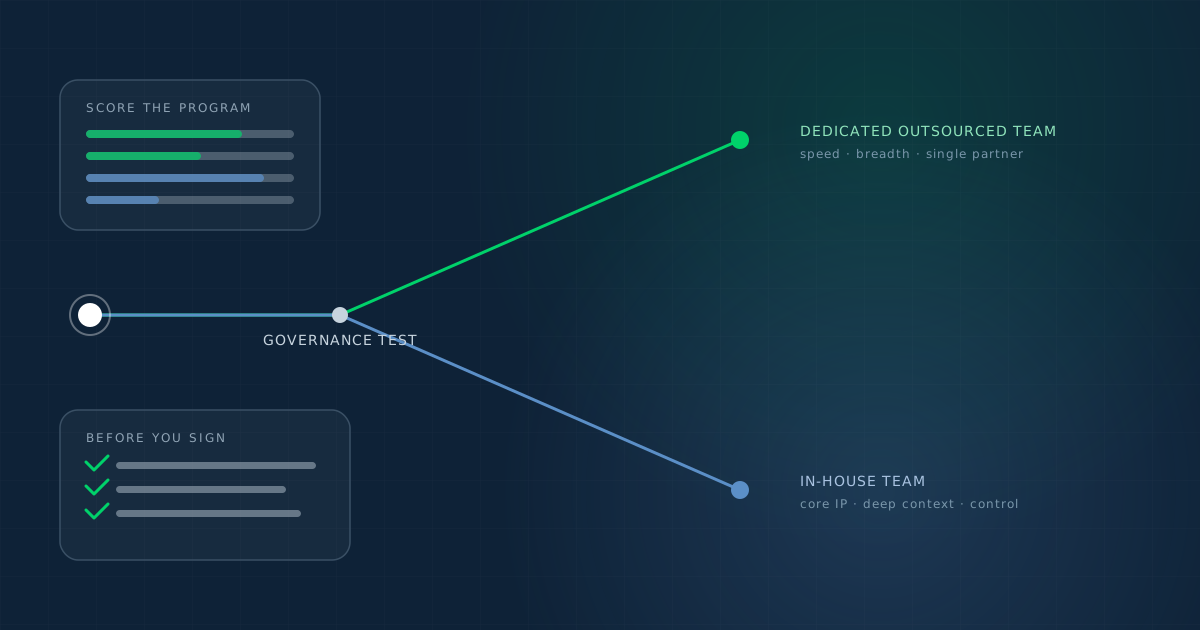
The Governance Test Most Comparisons Skip
Before choosing either model, ask a harder question: how mature is our own delivery governance?
Outsourcing doesn't remove the need for internal oversight — it changes its shape. A weak internal governance structure combined with a weak outsourcing partner is the worst combination available; you get neither control nor delivery discipline. A weak governance structure paired with a strong delivery partner — one that runs structured discovery, defined phases, and transparent reporting — can actually raise your delivery maturity, because the partner brings the process discipline your internal team hasn't built yet.
This is the real argument for choosing an outsourcing partner with a documented delivery process — Discovery, Strategy & Planning, Execution, and Optimization & Support — rather than one that starts writing code the week after the kickoff call.
A Practical Decision Framework
Score your program 1–5 on each of these. Higher totals lean toward outsourcing; lower totals lean toward in-house.
- Time pressure — How costly is a 3-month delay? (5 = very costly → outsource)
- Skill breadth — How many distinct specializations does this program need? (5 = many → outsource)
- Permanence — Will this team still be needed in 18 months? (5 = no → outsource; 1 = yes, permanently → in-house)
- IP sensitivity — Is this your core differentiator? (5 = yes → in-house)
- Internal delivery maturity — Do you already run structured PM, QA, and release processes? (5 = yes → either model works; 1 = no → choose a partner with strong process discipline)
Most enterprise and public-sector programs land closer to the outsourcing side of this framework — not because outsourcing is inherently better, but because most programs are time-bound, cross-disciplinary, and don't touch core IP.
What to Verify Before You Sign Anything
Whichever model you choose, confirm these in writing before the first sprint starts:
- A named, accountable delivery lead — not a rotating point of contact
- A documented security and data-handling policy, especially for regulated or public-sector work
- Defined QA and release gates, not "we'll test as we go"
- Reporting cadence and escalation path agreed before kickoff, not after the first missed deadline
The Bottom Line
The build-vs-outsource decision isn't a cost question. It's a risk-allocation question. Choose in-house when the work is core IP or requires deep, continuous context. Choose a dedicated outsourced team when speed, breadth of skill, and single-partner accountability matter more than permanence. And regardless of which model you choose, the delivery process — not the org chart — is what actually determines whether the program succeeds.
We cover the flip side of this same discipline — knowing when not to automate a workflow before it's validated — in AI Agents for Enterprise: Use Cases, ROI & 2026 Roadmap.