
"AI agents" has become the line item every enterprise roadmap includes and almost none can defend with specifics. Ask a leadership team which workflow the agent will own, what data it needs, and what happens when it's wrong, and the answer is usually vague. That gap — between the ambition and the plan — is where most AI initiatives stall.
This isn't an argument against AI agents. It's an argument for treating them like the operational tool they are, not a strategy in themselves.
What an AI Agent Actually Is (and Isn't)
A chatbot answers a question. An AI agent plans and executes a sequence of steps — pulling data from two or three systems, applying business logic, taking an action, and reporting back — with limited human intervention at each step.
That distinction matters because it changes the risk profile. A chatbot that gives a wrong answer is a bad user experience. An agent that takes a wrong action — updating the wrong record, sending the wrong email, approving the wrong request — is an operational incident. The implementation discipline needs to match that difference.
Where AI Agents Deliver Real ROI
Not every workflow is a good candidate. The strongest returns cluster around a specific profile: well-defined steps, high transaction volume, and abundant historical data to validate against.
Document-heavy operations. Contract review, invoice processing, claims intake — anywhere OCR and NLP can extract structured data from unstructured documents and route it correctly. This is one of the clearest ROI cases because the task is repetitive and the failure modes are easy to detect.
Tiered customer and internal support. Agents that triage, categorize, and resolve first-tier requests — with clean escalation to a human for anything ambiguous — reduce response time without removing human judgment from complex cases.
Internal knowledge retrieval. Enterprises with large, fragmented internal documentation (policies, technical specs, compliance records) see fast returns from agents that can retrieve and synthesize answers instead of routing every query to a subject-matter expert.
Multi-system data reconciliation. Repetitive tasks that require pulling data from a CRM, an ERP, and a spreadsheet, then reconciling discrepancies — traditionally manual, error-prone work — are strong candidates because the logic is rule-based and auditable.
Where AI Agents Are the Wrong Tool
Low-volume, high-ambiguity decisions. If a task happens twenty times a year and every instance requires nuanced judgment, the cost of building and validating an agent outweighs the return.
Workflows without clean historical data. An agent is only as reliable as the data it's validated against. If the underlying process has never been consistently documented, the agent will inherit that inconsistency.
Anything requiring unambiguous final human accountability. Certain regulated decisions — credit approvals, medical triage, legal judgments — should keep a human as the final decision-maker, with the agent supporting research and drafting rather than deciding.
The ROI Question Leadership Should Actually Ask
Instead of "what can AI do for us," a more useful framing is: which workflow currently costs the most in repetitive human hours, has the cleanest historical data, and has the lowest cost of an occasional error? That intersection — not the most impressive-sounding use case — is where the first agent should go.
A Practical Implementation Roadmap
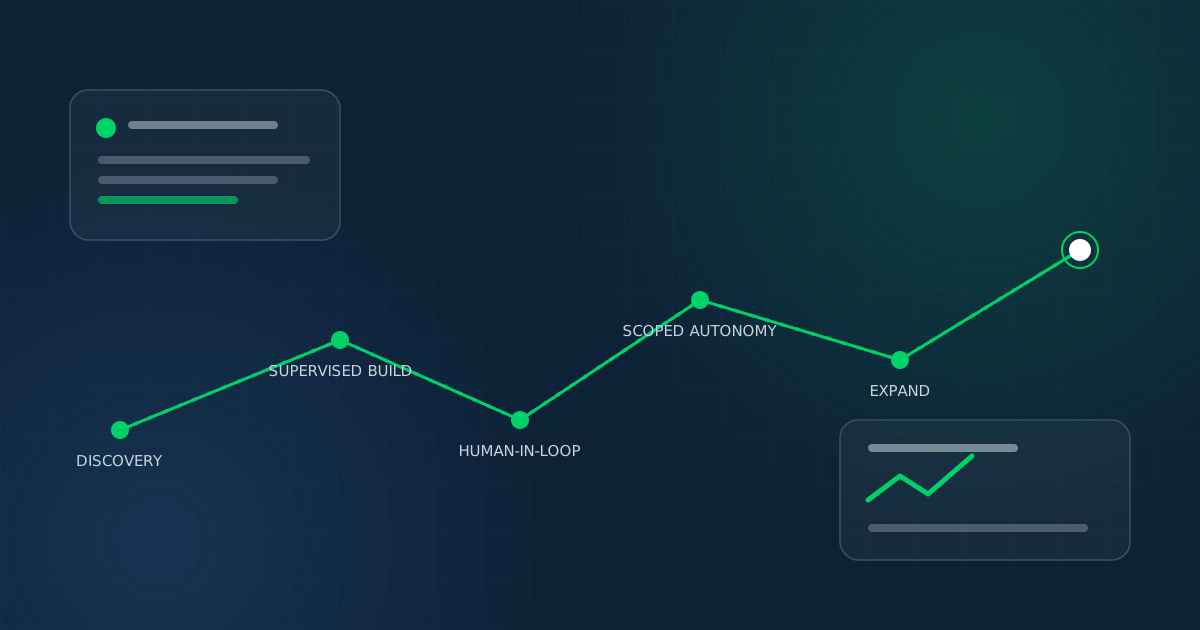
Phase 1 — Discovery (2–3 weeks). Map the target workflow step by step. Identify data sources, decision points, and where human judgment is currently applied. This phase should produce a clear "what the agent will and won't do" document before any building starts.
Phase 2 — Supervised Build (4–6 weeks). Build the agent against historical data in a sandboxed environment. Every action it proposes gets reviewed by a human before execution. This is where most of the real validation work happens — and where most rushed rollouts skip a step.
Phase 3 — Human-in-the-Loop Production (3–4 weeks). The agent runs live but every action still requires human sign-off before it executes. Track accuracy, false positives, and edge cases the discovery phase missed.
Phase 4 — Scoped Autonomy. Once accuracy holds steady across a meaningful volume of live cases, extend autonomy to the lowest-risk subset of the workflow first — not the entire process at once. Keep an escalation path for anything outside defined confidence thresholds.
Phase 5 — Expand and Iterate. Apply the same discovery-to-autonomy sequence to the next workflow, using what was learned about data quality and escalation design in the first rollout.
Skipping from Phase 1 straight to Phase 4 — building an agent and immediately giving it unsupervised authority — is the single most common cause of costly, trust-damaging AI failures inside enterprises.
Governance Questions to Settle Before Building Anything
- Who owns the agent's decisions when something goes wrong — the business unit or the technology team?
- What's the audit trail for every action the agent takes?
- What confidence threshold triggers automatic escalation to a human?
- How is the underlying model or integration updated, and who tests changes before they go live?
An AI agent without clear answers to these questions isn't ready for production, regardless of how well it performs in a demo.
The Bottom Line
AI agents earn their place in an enterprise stack when they're applied to specific, well-scoped, data-rich workflows — not as a blanket transformation initiative. The organizations getting real ROI in 2026 aren't the ones with the most agents deployed; they're the ones that picked the right first workflow, validated it properly before granting autonomy, and built a repeatable rollout process for the next one.
This is the same discipline behind our own AI & Intelligent Solutions capability — pairing OCR, NLP, and predictive analytics with a structured delivery process so automation gets validated before it gets authority.
If the constraint on your first AI agent rollout is internal engineering bandwidth rather than the use case itself, that's a build-vs-outsource question in its own right — we cover how to think about it in a dedicated delivery team versus hiring in-house.